Key takeaways
- Start from the daily output you can actually sell, not from the biggest machine you can afford.
- Semi-automatic QT4 machines suit 2,000–7,000 blocks/day; fully automatic QT8–QT15 lines suit 10,000–40,000+.
- Pallets, moulds and curing space often cost as much to plan as the machine itself.
- Ask for a layout drawing and a mix design before you pay a deposit.
Every week we speak with buyers who are about to spend their savings on a block machine. The most expensive mistake is not choosing the “wrong brand” — it is choosing a capacity that does not match the local market, the power supply or the workforce. This guide gives you the same decision framework our engineers use when they size a plant.
1. Start with the output you can sell
Estimate how many blocks your market absorbs per day. A typical 400 × 200 × 200 mm hollow block wall needs about 12.5 blocks per square metre. A single three-bedroom house uses roughly 2,500–3,500 blocks. If you plan to supply five houses a week, you need around 3,000 blocks a day — a semi-automatic machine handles that comfortably.
The model name tells you the theoretical output. In QT10-15, “10” is the number of 400 × 200 × 200 mm blocks formed per cycle and “15” the cycle time in seconds. Multiply blocks per cycle by cycles per hour and by working hours, then apply a realistic efficiency of 70–85% for mould changes, breaks and material supply. Use our capacity calculator to run the numbers for each model.
2. Understand the three automation levels
| Level | Typical models | Blocks/8 h (hollow) | Workers | Best for |
|---|---|---|---|---|
| Mobile / egg-laying | QTM4-30A, QTM6-24 | 2,500–5,500 | 3–5 | Contractors, rural sites, lowest capex |
| Semi-automatic | QT4-40, QT4-23A, QTJ4-35B | 2,500–6,700 | 4–6 | Start-up block yards |
| Fully automatic | QT5-15 to QT15-15 | 7,000–28,000+ | 4–6 | Commercial plants, government tenders |
Mobile egg-laying machines lay blocks directly on a concrete floor. You save the cost of pallets and stacking, but you need a large flat curing area and output per worker is limited.
Semi-automatic machines such as the QT4-40 or QT4-23A form blocks on pallets; workers carry pallets to the curing area. They are simple to repair and a sensible first investment.
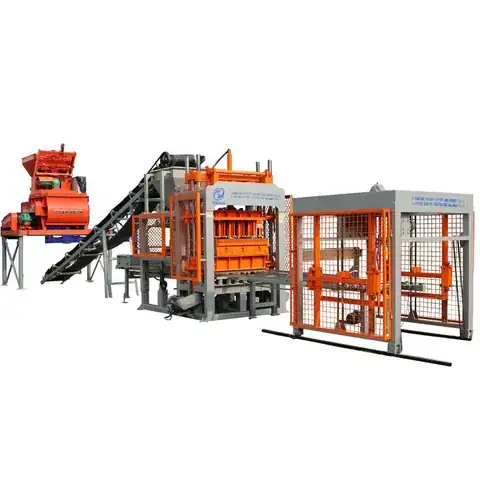
Fully automatic lines like the QT10-15 add PLC control, hydraulic pressing, automatic pallet feeding and stacking. Output per worker rises sharply and block density is more consistent — important when you sell to engineers who test compressive strength.
3. Check your power supply and site
- Power: a QT4-40 needs about 16 kW; a QT12-15 line about 36 kW plus mixer and batching. If grid power is unreliable, size a diesel generator at 1.5× the connected load.
- Voltage: we build to 220, 380, 415 or 440 V and 50/60 Hz — confirm yours before production.
- Space: semi-automatic plants work in about 60 m² of covered workshop plus a curing yard; automatic plants need 250–300 m² covered plus 1,000 m² or more for curing and storage.
- Water and aggregates: a reliable supply of clean sand and 0–10 mm crushed stone matters more than any machine feature.
4. List every block type you will sell
One machine can make hollow blocks, solid bricks, interlocking pavers, curbstones and hourdis slabs — but only with the right mould. Moulds are wear parts; budget for at least one spare of your best-selling block. For colour pavers, ask for a face-mix feeder: a thin coloured top layer saves 70–80% of pigment compared with full-body colouring.
5. Plan the hidden costs
Buyers often forget pallets. A semi-automatic plant needs 600–1,000 pallets; an automatic line 1,000–2,000. Pallet choice — PVC, GMT, steel or wood — changes your cost per block for years. Read our pallet comparison before deciding.
Other line items: mixer, batching, cement silo, loader or forklift, foundations, shipping, installation travel and spare parts.
6. What to ask a supplier
- A layout drawing of your plot with every machine positioned.
- A mix design for your local aggregates and target strength.
- The full electrical load list and recommended cable sizes.
- A video of your machine running before shipment.
- What installation, training and spare-parts support is included.
Our engineers will answer all five in writing. Send us your target output and block sizes and we will recommend two configurations with a budget for each.
Frequently asked questions
What does QT4-15 mean?
QT is the Chinese abbreviation for a concrete block forming machine. “4” is the number of 400×200×200 mm hollow blocks per cycle and “15” is the cycle time in seconds.
How many workers does a block machine need?
Most semi-automatic machines run with 4–6 workers. A fully automatic QT10-15 or QT12-15 line runs with 4–6 workers as well, but produces three to five times more blocks.
Can one machine make pavers and hollow blocks?
Yes. Concrete block machines change products by changing the mould, which takes 20–40 minutes.